All posts by Kristi

Kristi Beisecker is a graphic designer, photographer, printmaker and alternative scientist whose interested in making images through two contrasting elements. She is also a blogger in lifestyle, travel, wellness and health, art and design, beauty and fashion.

Experiments: WTA – Ferrofluid Attempts #1

Thoughts:

  • I used too much, or didn’t dilute it enough – a little goes a long way
  • Didn’t realize my LED strip needed an adapter to plugin into the wall so no light source at the moment
  • Fun playing around with the fluid dynamics of ferrofluid
  • The circular pieces of glass I bought weren’t clear at all so I am not able to use them
  • Fun playing around with something I’ve read so much about

Project: WTA – Ferrofluid #1
Year: 2018

First attempts with ferrofluid. Nothing special just fluid dynamics doing its thing.

WTA – WereWool

One of my advisors is currently working on a project at the Fashion Institute of Technology for the BioDesign Challenge in creating fibre from proteins the project is called – WereWool.  I am posting this here to save for future reference for my Weaving and Textile Arts research interest.

WHAT IS WEREWOOL?

A 2018 Bio Design Challenge project that is trying to create a new class of fibers by synthesizing proteins that are genetically altered to bond together, using an enzyme called Transglutaminase to create a new platform for fiber innovation.

The growing consumer demand for fast fashion and it’s environmental and ethical impact has led companies to seek more sustainable sources of fiber.

We are creating a new type of biomaterial. The fiber formation system we are creating has the potential to create an easily accessible platform for sustainable material development; integrating synthetic biology into the design phase of the product lifecycle.

Werewool is trying to address the impact of the wool industry and it’s current market alternatives.

Our fiber is produced by harnessing the tools of synthetic biology, our own bodies proteins, and the power of an enzyme glue.

We can provide a fiber source that requires minimal inputs, is completely biodegradable, is environmentally friendly and cruelty free!

Realize: Through the Scope

During this trip to Costa Rica, I finally found some new inspiration. I went on the hanging bridges tour at Mistico park and the tour guides had these large scopes to view wildlife from afar. I had impressed a bunch of people on the tour by putting the ipod/smartphone up close to the scope to take a picture. I had learned this from my residency in the overgrowth forest. I think I will purchase one, one day to add to my tool box. This also inspired a new photographic series, “Scopeography”; in which contains series of images taken through the ‘scope; micro or other. I realized that this series also can have kaleidoscopes as well as micro or other types.

Activities: Hanging Bridges

One of the main activities of my trip to Costa Rica over 10 years ago was a trek up the mountain, through a rainforest to an indigenous village of the Cabecar indian tribe. This was before the age of google, and blogging and travel PR… I had my travel notebook with me (no laptop!) and took down notes about this secluded culture; their religious views and way of life and quite frankly I was so fascinated by the entire experience. Unfortunately, I overexerted my body and I think jump started my hypothyroid issues since I spent close to 14 hours hiking within one weekend. Afterwards, I pretty much slept whenever I could and did the rest of the activities in a bit of a daze. So going back there, was huge. I had quite a few flashbacks of this trip, seeing the hills and remembering spending time resting and taking in the landscape. It was quite an interesting experience, now that I live in western Mass to compare the volcanic mountain range of Costa Rica to western Mass. Very similar in regards to the animals and lifestyles. However, one is obviously tropical and with that a variety of different plants, animals and insects. From a research perspective, it is an ecological paradise and a place I think I’d like to spend some more time in.

Going back, I wanted to re-experience a few things, so I did a hiking activity and did the hanging bridges. Since that hike over 10 years ago, I’ve been interested in hiking/walks through the woods. Nothing too strenuous, but enough to take in the landscape and photograph the nature around me. Since moving to western Mass, I have been interested in doing nature hikes/walks around the trails here learning about foraging and other nature topics. However, since Costa Rica, it’s come to my attention that I have heat exhaustion and over the years have learned to control it and catch it before my body overheats. I was quite happy with myself that I only had one incident on the hanging bridges tour and thankfully the rest of it was quite easy to do. Regardless of my health issues, I quite enjoyed being in the rainforest – as I’ve done in the overgrowth forest in Canada and around here in western Mass.

In my next nature adventure, I think I might try hiking alone. While I very much appreciated the tour guide as he spotted a few things that I wouldn’t have seen and provided information that was interesting about the landscape; it was a bit difficult to take photos and really spend sometime with the rainforest. I am getting a better sense of what I have to work with while traveling and I think next year I’m going to try and take some of my traditional art materials with me.

Inquiry: Rediscovering Heart of Palm

LA FORTUNA, CR – I’ve been to Central America several times now and this is the first time that I’ve ever put a name to a vegetable from that area of the world. Perhaps it was because I had been traveling all morning that made it taste especially good, but I recently rediscovered the vegetable; heart of palm. I had the cream soup at Arenal Kioro, several times in fact. Who knew a tree could taste so good.

Hearts of palm are tender, white cylinders that have a mild flavor similar to artichokes. They’re often found in salads but can also be cooked and served as a side dish. Hearts of palm are low in calories and a good source of vitamins, easy to find in grocery stores, and can be added to any healthy, balanced diet.

High in fiber with a good chunk of protein and a low glycemic index, hearts of palm make a welcome addition to vegan diets, low-carb diets and even the healing diet, which is focused on decreasing inflammation and lowering blood sugar to optimize health. They also fit in well to many different dishes, from salsas and stews to quiches and casseroles. Heart of palm is incredibly versatile and often used as a meat substitute for those on a vegan or vegetarian diet. It’s also revered for its health-promoting properties and is especially rich in fiber, protein, manganese, iron and vitamin C.

Here are some additional information about Heart of Palm (source: Specialty Produce). From a nutritional perspective:

Description/Taste

Hearts of palm is encased in a tough cylindrical, ivory husk. Inside is a velvety, tender flesh that is delicately flavored. Tasting somewhat like an artichoke, it has the appearance similar to that of white asparagus. About four inches in length, individual hearts may be as thin as a pencil or measure nearly one to one-and-one-half inches in diameter.

Seasons/Availability

Enjoy Hearts of Palm year-round.

Nutritional Value

Containing no cholesterol, fresh hearts of palm is a good source of nutritious fiber.

Applications

Hearts of palm may be packaged fresh, or jarred in water, and may be served raw or cooked. Steam or peel outer husk if still intact. Slice and add to salads, grains, pastas and fresh salsas. Top pizza with thin slices. Stuff or fill hollow cavity with cheeses, meats or herbs. Add to stews, chowders, quiche and casseroles. Mild in flavor, hearts of palm pairs well with greens and seafood.

Ethnic/Cultural Info

Also known as “swamp cabbage” or “millionaire’s salad”. Favored in Costa Rica, “Picadillo de Palmito” is a traditional dish.

Geography/History

Young stems produced by a palm tree known as “bactris gasipaes”, hearts of palm have been cultivated in Central America since the time of the Mayas. In the Republic of Panama, Central America, top quality hearts of palm thrive in the rural area of Panama. Also field-grown in the tropical humid areas of Costa Rica, hearts of palm are, literally, the heart of the sabal Palmetto tree. This spectacular tall tough-barked palm is the state tree of Florida and is protected by Florida state law. The hearts of palm grown in the United States are mainly from Florida.

ref: https://draxe.com/hearts-of-palm/

Residency: Personal Wellness at Arenal Kioro

LA FORTUNA, CR – Arenal Kioro offers a fabulous place with a natural viewpoint to the Arenal Volcano which make a great retreat for Personal Wellness. The hotel has 27 acres of undulating land, surrounded by two streams (La Palma and Kioro) with crystalline waters that begin to flow in the Arenal Volcano National Park. Private Thermal water surround exuberant gardens for our guests´ pleasure.

The hotel hosts 53 suites, 11 with one king bed and a daybed and 42 with two Queen beds and a daybed, with two “Juliet” balconies with the best panoramic volcano and mountain view , hydromassage hot tub, air conditioning, safe deposit box, minibar, coffee maker, hot water, direct dialing telephone, cable television, hair dryer, key card, safety locks and wireless Internet.

With Costa Rica being a short 6 hour flight away from Boston, it makes a great getaway destination. Surrounded by lush greens and flora, the Arenal Volcano makes for a luxurious backdrop for a personal wellness weekend. Staying at a suite and spa resort promotes personal wellness; everything from scrumptious Costa Rican dishes to accessibility of the hot springs and an experience at Arenal Kioro gives you a sense of green luxury, promoting sustainability practices to help keep the area green and lush. 

Arenal Kioro also offers tours and activities to give you a chance to explore the area. It is always convenient to work through a hotel to organize excursions in the area. I took advantage of the hanging bridges tour since that was something different than my last trip to Costa Rica that I hadn’t done. After the tour, I spent the afternoon sipping Pina coladas and mojitos and enjoyed the hot springs. Despite the rainy weather and season, I went into the experience embracing it as the locals would say – Pura Vida!

Inquiry: Signs of Spring

Spring has been in full swing for the last several weeks, but this time of year has to be my absolute favorite. Studying botany and/or using organic materials in artwork can be difficult in the winter, as everything is literally frozen over. When I can start foraging for mushrooms, seeing botanical gardens and collect specimens for my studio to dry and/or use in my artwork I feel more complete. Spring and Fall in New England also has to be my favorite seasons. On Sunday, a Dryad’s Saddle popped up under the young maple tree out in my backyard and at the beginning of the month, the lilacs were in bloom at Harvard. With the plants in bloom and to continue in bloom, it’s easy to feel abundance of inspiration during these times.

Hunab Ku

The Origin of the “Hunab Ku” Symbol

“The Origin of the ‘Hunab Ku’ Symbol”

Sept. 24, 2006

http://www.diagnosis2012.co.uk/new10.htm#hunab
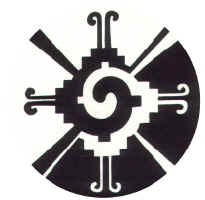
Hunab Ku

The “Hunab Ku” symbol, is widely presumed to be a Maya representation of a major Maya deity and the centre of our Milky Way galaxy. You can find a representation of it at the centre of the Dire Gnosis logo on the index page of this website.  Anthropologist John Hoopes recently asked the Year 2012 discussion group if anyone could pinpoint any Maya sculpture, ceramic vessel, or other Precolumbian Maya source where it is shown.

The discussion brought out some interesting facts, summarised as follows:

The symbol became widely known when Jose Arguelles published The Mayan Factor in 1987, where it appears in circular form on the cover of the book, and as part of many illustrations. On p. 32, a rectangular version is labelled “Hunab Ku”, and on p.52, the rectangular version is shown and labelled as “Hunab Ku: One Giver of Movement and Measure”. On p. 30-32, Arguelles explains that in 1968, he visited a little town called Teotitlan del Valle near the Zapotec site of Monte Alban in the mountains of Oaxaca, in central Mexico, and he was shown two rugs with this pattern on them in a textile shop. He bought one in blue and orange.

The connection between the title of Hunab Ku and the design is not explained by Arguelles, but seems to have come via the modern Maya day-keeper, Hunbatz Men. Arguelles says on p.40 that he met Hunbatz Men in 1985, and admits that he was heavily influenced by him. The following year, in 1986, Hunbatz Men published a book in Spanish called Religion Ciencia Maya, (published in 1990 in English as Secrets of Maya Science/Religion), he says that the Mexicas (Aztecs) worshipped Hunab Ku, and they (as well as the Mixtecs), also worshipped the Milky Way, as represented in the “G symbol” (p.40-41). Men calls Hunab Ku “The Only Giver of Movement and Measure”, and at the bottom of p.34 he says that “in order to understand the sacred Hunab Ku…one must venerate the origin of zero, the Milky Way…”.

According to the official Mayanists, such as Sharer, Hunab Ku means “one god” in Yucatec Mayan language, and was the creator of the universe and equivalent to Itzamna, but “Hunab Ku seems to have figured little in the life of the ancient Maya and no representations of Hunab Ku have been identified in the codices or elsewhere.”

In John Major Jenkins’ 1998 book, Maya Cosmogenesis 2012, he shows the rectangular symbol, (p.329) and says it originates in the Nuttall Codex (a pre-conquest Mixtec document named after Zelia Nuttall who identified and published it), but after failing to find it in the the Nuttall codex, Hoopes contacted John Major Jenkins, who said he had seen the symbol as a frontispiece House of the Dawn – in a romance novel by Ryan, published in 1914, and also in an academic work by Zelia Nuttall, but he’d rechecked and it was not in the Nuttall Codex.

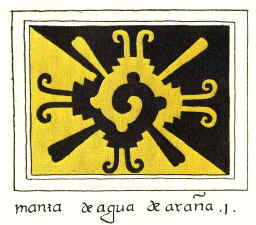
Next,  I located the symbol in its rectangular form in a 1922 edition of Herbert J. Spinden’s Ancient Civilizations of Mexico and Central America (p.220), with the caption, “Mexican blanket with the design representing sand and water”.

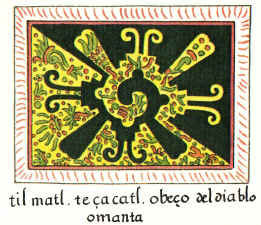
John Major Jenkins finally settled the matter, when he found the rectangular design in the Codex Magliabecchiano, published in 1903, with a commentary by Zelia Nuttall, which is an Aztec document and dates from some time before 601. Hoopes went on to find that the codex shows variations of the rectangular design, and says they are “mantas” – mantles or ritual cloaks that were used in festivals – in particular, the festival of  lip plugs. The word for lip plug was originally mistranslated as spider water, which is given in the caption.

So, in summary, the “Hunab Ku” symbol was originally a rectangular symbol used by the Aztecs as a ritual cloak design, known as the Mantle of Lip Plugs (or, arguably, mantle of spider water). The symbol survives as a rug design being sold in central Mexico, but was associated with the Milky Way and the god Hunab Ku by Jose Arguelles in 1987, who changed the symbol to a circular one. This is how the symbol appeared in the 16th century Codex Magliabecchiano:
Introducing… MagKnotic!

It’s been about a year since switching gears to my artistic practice. The electrography collection literally came to me via psychic insight and I was able to follow that insight at the time. I was in college at the time, and deep into my research interests when the idea came to me and with the help of my father – he was able to help build the device I needed to pursue the project. My professors encouraged me to build a legacy of images surrounding this style of photographic art. I have been deeply terrified of following other ideas due to them not having any sort of structure to measure success or to define the project to be successful. Through the years of exhibiting my electrography collection I’ve been teaching myself how to measure the success of this project so I can embark on other projects and ideas that are similar – which is why and how I devised the research framework. I had realized my electrography collection came from my research interests and once I defined a framework for that, my other ideas for projects developed nicely.

This past year I have done an enormous amount of soul searching and figuring out what and how I would conduct my artistic practice. I have 8 research interests that are propagating that I see unfolding over the next 5-10 years. I have felt very blessed that my first steps into the art world professionally have been met with success, but it is also terrifying to me to try to follow and continue these steps. Of the 8 research interests, only a few have stuck with me as something to pursue and that are feasible to pursue in the moment.

One of the things that was brought to my attention is that much of the opportunities that I pursued were in order to help other organizations continue to run. Which is fine and all – perhaps for an entry level artist – however, I feel at this stage of my career there should be less of that and more things carried out and organized on my own. So this means having a full body of work ready to be displayed when submitting to calls for exhibition, learning how to apply for grants and securing funding for larger scale projects, collaborating with larger institutions and universities to carry out work that is beneficial to the people involved, among other things. When realizing that I have the skills to conduct these projects essentially on my own outside of the established boundaries of art, it is quite freeing. I do not need that residency or development course to carry out a project – utilizing the resources at hand, I can carry out these projects myself.

The universe has a funny way of working… I have been working on this new artwork series within the last month and just the last couple of days an opportunity came through within my network for me to go back to my artistic home – Italy – to potentially work with a textile manufacturer in a collaborative project. I had been feeling a pull to work on my research interest of weaving and textile arts  and this synchronicity has sort of confirmed it for me. I have put several ideas out into the universe and seems to me that this one will lead somewhere. Which leads me to introduce the project…

MagKnotic! A series of textile arts that are inspired by magnetic fields visualized with ferrofluid and light. This project is about the theory that weaving and textile arts, specifically Celtic – as well as others, contain meanings embedded within the knots, forming a language. For example, a comparison between an image of the earth’s magnetic field and the Celtic tree of life depicting the exploding/imploding energy. An implosion is simply the opposite of an explosion. In an explosion, matter and energy fly outward, but in an implosion, matter and energy collapse inward. So in short, implosions are caused by having a greater pressure on the outside of an object than on the inside. For the purpose of this project, it will focus on the Celtic knotting methods and it’s correlation to magnetism. However, this project can extend to other cultures such as South America and as far as East Asia.

WTA – Magnetic Warp

[vc_row][vc_column width=”2/3″][vc_empty_space][vc_column_text]

Michael Snyder of the University of Louisville has been working on developing imaging techniques utilizing two ferrofluid Hele-Shaw cells that have been constructed to facilitate the imaging of magnetic field lines. His results are distinctive and show similarities to sacred geometry and Celtic weaving.


[/vc_column_text][/vc_column][vc_column width=”1/3″][vc_empty_space][/vc_column][/vc_row]