All posts by Kristi

Kristi Beisecker is a graphic designer, photographer, printmaker and alternative scientist whose interested in making images through two contrasting elements. She is also a blogger in lifestyle, travel, wellness and health, art and design, beauty and fashion.

String Gardens


I may not have a green thumb, but who knows because my dad has a garden… but for me I think the biggest problem is sun. My room is pretty much under a huge maple tree and get barely any sun through my windows. Our property is pretty shady (lol) in general so we can’t have much of a garden. Though in my town there is a section blocked off for community gardens and that’s where my dad has his.

If I ever live in a place that has enough sun, I’m gonna grow a stringing garden.

Here is a website dedicated to stringing gardens: http://www.stringgardens.com/index.php?/summer-2009/

Walk

My Kaolin Clay came today. I hope to get Rabbit Skin Glue soon and then seeing if I can replicate that Smart Mud recipe.

I am debating about getting 1lb of rabbit skin glue or try and find a smaller version online. I have a gift card to dick blicks and buying the rabbit skin glue would use up most of what is left.


I love plant texture. I went to take advantage of some of the sun that came out today, but ended my walk because it started to thunder again.

I think I want to become a micro photographer. I just love the microverse and seeing things you wouldn’t normally see. I think when I get a camera upgrade I will ask for one that will take micro pictures.

…woes.

You know you’re week turns bad when you lose a client….

I’ve been dealing with this chick since last summer. I was going to do her logo, ppt template and letterhead. We agreed, put down the deposit. I gave her a comp, and she told me a co-worker had a problem with the concept. After that I never heard back from her. I kept calling, emailing her for months. I thought, okay so this project isn’t on this chick’s top priorities. Fine. I had school, etc. I emailed her this month asking what’s up. She told me that she needed the project done while I was at school. Um. She gave me the project mid-summer, could’ve gotten the project done if communication had been swift. She had given the project to some other studio. Um okay, but wasn’t the whole point of the deposit to prevent this from happening?

I thought that’s what deposits were for.

To prevent canceling projects.

Well after dealing with this chick, I’m going to have to draw up some guidelines.

symbol quotes

Its said that symbolism is the first veil. The initiate or student of mysteries begins his path with this most important tool. With an understanding of this symbolism the old wisdom is revealed. – Magical Egypt – The Invisible Science.

“Symbolism is the language of Magic” – Egyptian Mystery Schools.

“…Magic is the traditional science of the secrets of Nature which has been transmitted to us from the Magi.” Eliphas Levi

Chromaphonoglyphics

CPG

“bringing color to human language”

CHROMAPHONOGLYPHICS

conceived and developed
by
Richard Brodie

CPG is a new writing system for the English language which achieves a unified system, melding the best aspects of the world’s two principal writing paradigms: Western alphabetic scripts and Eastern logographics. It features three important innovations. First, it introduces the concept of using colors (chroma) to represent vowel sounds. Second, it treats consonant blends as letters in their own right. Third, it combines the phonetic (phono) principle of western alphabets, with the eastern practice of representing words as pictures (glyphics) which fit into uniform squares.

(The following expresses the same thing with CPG)

Overview

CPG is not intended to be written by hand. The variety of colored pens that would be required, as well as the extreme precision with which the various consonantal features need to be placed, make it unsuitable for manual use. This particular linguistic development has had to await the advent of computers. I have used Adobe’s PostScript language to write the CPG software engine.

CPG is, in an abstract sense, featural. Vowels, represented by colors, form the two-dimensional central body of a syllable, with consonants being the enclosing one-dimensional perimeters. Visually, this is analogous to sounds produced by the vocal apparatus, vowels having a one-dimensional extension through time, with consonants being zero-dimensional (or as they are sometimes characterized, “the sound of silence”), bounding the extremes of a vowel’s duration. A more concrete featural aspect is the use of two adjacent small interior open circles to indicate nasalized consonants, a design meant to suggest the human nostrils.

Syllables within a word are stacked vertically from top to bottom, with their heights compressed as necessary depending on how many a word contains. Words, on the other hand, extend in a horizontal direction from left to right. Finally, punctuation is indicated by black-and-white pattern-filled shapes appended at the bottom (or top) of the word after which they would be postpended (or before which they would be prepended) in normal writing. Consonant blends occupy the same amount of space as pure consonants, and should be thought of as individual letters, just as in ordinary writing vowel blends such as long I (a blend of short O and long E) are regarded as individual letters. Thus the CPG “alphabet” consists of 223 letters (25 basic consonants, 13 vowels, and 185 consonant blends). As you study the various kinds of blends you will be able to appreciate how the different basic consonant shapes were chosen so as to satisfy the constraint of having to nest within each other as necessary, based on their natural usages and sequencing in the English language.

The following links provide detailed descriptions of CPG’s various components:

Consonants | Vowels | Blend Overview | Leading Double Blends | Leading Triple Blends | Trailing Double Blends | Trailing Triple Blends | Trailing Quadruple Blends | Punctuation | Numerals

CPG and Linguistic Bandwith

Please note that I characterize eastern (kanji) writing systems as logographic rather than ideographic. This is in accordance with the modern understanding that in the Chinese system, characters represent sounds not ideas. I would prefer to call it syllabographic, since each character always stands for a syllable. But due to the large amount of syllabic homonymy, it is often the case that entire words do not require more than one character, and so it is largely, though not entirely, a logographic system.

The Western alphabetic approach may be regarded as a letter-serial linguistic data communication channel. A reader’s eyes are marched along a one-dimensional line of letters, each one standing for a single phoneme of information. These individual letters have structure, consisting of a single line, or two or three connected lines, but the experienced reader does not have to visually retrace these lines each time they are encountered. Repeated exposure leads to perceiving them as units, primarily because they are distinguishable graphic figures laid out in a two-dimensional area.

Imagine if these sub-components were broken apart and strung out linearly in the same way we do with letters, the subcomponents of words. With the following 14 elemental stroke segments:

we can define an exploded version of the alphabet as follows:

It should be obvious which of the following two versions of the same phrase more readily communicates the informational content:

linguistic bandwidth reduction resulting from alphabetic fragmentation

Now imagine that we proceed, not in the direction of increasing fragmentation, but in the opposite direction of increasing amalgamation. Rather than segmenting letters into smaller sub-components, suppose that we instead treat letters as sub-components of words connected into a single two-dimensional graphic. Just as letter fragmentation resulted in a slowing down of the linguistic data transmission rate, we should expect to see a speeding up with lexical amalgamation – especially if, by using color, those retinal communication circuits associated with cones are opened up.

linguistic bandwidth enlargement resulting from lexical unification

To recapitulate, in the first example the subcomponents of letters (strokes) have been separated, resulting in 64 letter elements being replaced by 104 stroke elements. In the second example 61 letters have been unified into 7 lexical elements, not merely by interposing separating spaces, but by creating highly distinct, non-fragmented colored glyphics, recognizable at a single glace as perceptual units.

SOURCE: http://www.richardbrodie.com/CPG/CPG.htm

I love this!!! I am going to spend some time reading about this alphabet.

Creative Science Layout

I’ve been thinking about starting a blog about science with an artistic approach to it. Its kinda hard to describe but, maybe you’ll see. 🙂

Layout created in Photoshop… used Leonardo Da Vinici bruches.

It’ll be similar to this one, but with a more narrow focus.

If I don’t turn this layout into a blog layout I might use it as a future re-design of my site. 😛

And I wish I had his style.

Mother’s Day Card


So we’re celebrating mother’s day tomorrow within my family because we went to my grandma’s house on Mother’s Day. I also came home that same weekend and they wanted to celebrate tomorrow.

So we’re going to the MFA tomorrow to see a glass blowing exhibit, having sword fish, artisan cheese + presents.

I couldn’t find a card for mother’s day so I decided to make one.

A small project. But turned out well. You probably can’t tell in the photos but my type came out a bit pixelated. Not sure why because I saved and printed it at 8.5 x 11. Hmm Oh well.

Symbols

The language of dreams is particularly remarkable; for the images of dreamers are not always known and easily understood appearances; they are often starting symbols whose meaning it is difficult to express in common words, and which the dreamer himself is seldom able to unriddle; on which account it was customary in ancient times, and particularly in the Temples, to have interpreters of dreams. From this arose the science of expounding dreams (oneirocritica, oneiroscopia). It is, however, the language of poets and prophets; that is the object and the image are one; and it seems that the primitive language and the language of God to man was symbolic. The language of dreams is the same in the most dissimilar men and nations; the prophet and the seer, the true poet, the magnetic clairvoyant, and the prophetic dreamer, more commonly use this language than that of common intercourse. In it lies such a fulness of meaning, and combination of times and objects, that the most comprehensive prose is unable to give its full expression. As common than at present, when the outward sense are more distracted with occupations of the mind, so do we find that symbols and hieroglyphics were more common; as among the Indian seers, the Israelitish prophets, the Greek oracles, and the old picture-writing of the Egyptians, and the votive tablets of the Temples. It is similarly connected with art. This was also symbolic in its architecture; for art is but the expression of the inner genius which inspires the soul of the artist, or the imagination of a people, and is intimately connected with religious feelings. The expression of art is, therefore, but the true language of the seer, and therefore mostly as symbolic in meaning; as for instance, the Ark of the Covenant, which arose by divine inspiration, and then expanded into the Temple of Solomon; till at length Christian architecture, in universal freedom and purity, as it were, cast off all the oppressive weight of earthy matter, and with its pointed arches, vaulted roofs, and towering spires, strives upwards towards heaven, as if to receive the glorious power descending from above.

Source: The History of Magic by Joseph Ennemoser

Paper: The Shining Ones and Angels

Chapters of Coming Forth By Day: “Behold, oh ye shining ones, ye men and gods…”

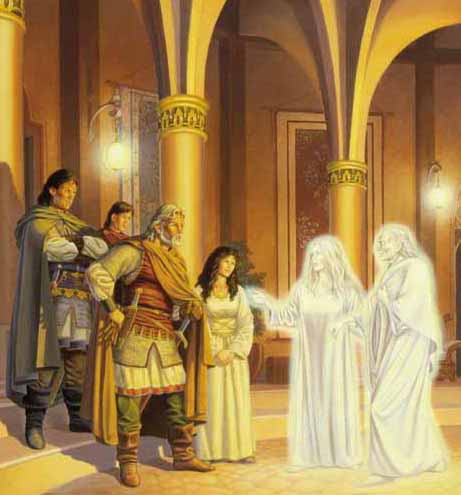
One of the missing “keys” in this fabricated divided illusion, is the shining ones. Throughout ancient history, there has been a global phenomenon of beings called the shining ones. They have literally been described as people of light and that they were seen as gods. The most prominent culture who speaks of the shining ones, is of course Egypt. But some scholars believe they are the Sumerian Annunaki. In the Sumerian legends, Humanity was created by the Sky Gods who descended from heaven. I believe the angel archetype is actually a description of the shining ones. While the video below is not of actual human form, it still portrays the angel archetype. As seen in the video below, we could never accept the appearance of an angel because we would associate them with “UFO”s. That’s right. Some of the UFO footage is indeed “legit” but they are not like the image we have of aliens: a flying saucer with little green men inside.

In order to study Ufology a good understanding of light needs to be achieved. How it affects us, how it affects material, the acceptance that outside this physical world time and space do not exist. According to Hermetic thought, time and space is not in motion, but is perceived within thee. That means our brains are a big tool in perceiving the physical world. All our senses create the physical world. Without them, time and space do not exist.

Angels are described as white winged, beings, generally dressed in white and carry a message.

Well this description could be an archetypal description. These paintings that we know now, also were painted by the Humanists of the Renaissance who have a connection to the Order of the Rosae Croix, Rosicrucianism, a mystery (oral) school that was started by egyptian Pharaoh Tuthmosis. Therefore one of the many ways that mystics encrypted information was through paintings and symbols. As learned in art school, artists’ paint what the see. The act of seeing could mean different things to different people. The most obvious and narrow meaning to see is seeing something with your eyes. To the Humanists as well with any philosopher one of the many lines of wisdom that is passed around is, “Those who know, see.” This simply means, those who are ‘in the know’ see. See through the illusion.

Here are some quotes regarding the Shining Ones:

The Sumerian EL means simply bright or shining
the Old Irish Aillil means shining
Old Cornish EL means shining
Elf means shining – hence Elves as tall/mysterious angelic beings
Inca Illa is bright or to shine
Babylonian Ellu is to shine

Eliphas Levi (19th century magician and mystic) speaks of these egregors on numerous occasions and even links them to the giants or Watchers spoken of in the Book of Enoch saying that they:

“take shape and have appeared in the guise of giants: these are the egregors of the Book of Enoch…. Termed the celestial watchers or egregors, by the ancients.”

“The egregore is a group spirit that serves to remind the initiate of his or her goals. It informs and guides the individual and it protects the living chain of brotherhood. The living chain of brotherhood is entered into when a Setian performs a rite of their own creation intended to protect and enhance the Temple of Set. The egregore protects the brotherhood by letting them know their enemies are there. A symbolic representation of the egregore is used to maintain a link to the Prince of Darkness.”
Sir Ormsond IV°,
from Saturnian Principles.

[ngd-single-post-view] 

Experiment #1: Recycling Plastic

So one of the things that’s been boiling in my mind is trying to recycle plastic from Clear Splash Water bottles. Why? Because i drink a lot of them.

Last summer I observed that if you gently heat up the plastic it becomes like a hard glass-like material. I used a hand held gas candle torch (the kind you’d find in a christmas tree shop). I wanted to scale this and possibly make an awesome material from this to be used as a replacement for plastic.

I tried today, and I’m glad I tried when my mom wasn’t home and I’m glad I tried with a pyrex mixing cup my mom found at the town dump for me to use at the suite because I broke it. The bottom completely broke off.

I guess I forgot that I GENTLY heated it. I skipped the gently part and put the oven on High and I guess the mixing cup was cold from being in the garage and I know that glass heated immediately after being cold breaks…

I thought it would be alright Gently heating the plastic in a 2 inch thick pyrex mixing cup.

Then when I was wrapping the mixing cup up in bags to avoid being cut, I cut myself on the glass. And got a nasty gushing cut in which I got blood everywhere. =/ Its okay. I should be fine.

So I don’t know if I’m gonna try and glue the mixing cup back together or just throw it out the next time I’m back at school.

I think I’m going back to the dump to look for a stainless steel pot to use instead of glass. Glass is so risky.

What is Freemasonry?

What is Freemasonry?

Freemasonry is a system of science, as well as morality, veiled in an astronomical allergory and illustrated by astronomical symbols.

Source: Stellar Theology and Masonic Astronomy by Robert Hewitt Brown 32 (degrees) and ILL.:.B.:. Clifford E. Hazel, 33/96 (degrees).

NOTE: Pharaoh Hatshepsut co-ruled Egypt with her young nephew Tehuti mes III [Thutmose III] between 1473-1458 BC.

The Freemasonic Arts


NOTE: Around 2500 BC the above perfectly ground and polised crystal was used by the ancient Egyptians as a magnifying glass, for observing the stars and; serving as optical lenses in their statues. Khufu is Pharaoh Djoser’s grandsom. Netjerykht [Djoser[ reigned over the Saqqara Complex in Egypt around 2650 BC.

The seven liberal arts and sciences of the Phre-Mas-Sens are Grammar, Rhetoric, Logic, Arithmetic, Geometry, Astronomy and Music.

Source: The Secret of All Ages by Manly P. Hall and; The Crystal Sun by Robert Temple.

Symbols and Freemasonry

Freemasons use “Symbols’ to convey messages. According to ones perception a “Symbol” can be used for good or evil. One may not be able to read the above language. But, their “Symbols” are easily understood. Failure to comply with the rules associated with a “Symbol” may result in injury. the Masonic Square symbolizes the earth, truthfulness and integrity. The Compass symbolizes the spirit, self-control and staying within the bonds of humanity. The letter “G” symbolizezes Geometry and the Great Architect of the Universe (the arching characteristic of electricity, as symbolized in the ATOM symbol).

The secret of the pyramids

The mystical Phre-Mas-Sens of old use mental power also known as magnetic current to levitate those mega-ton pyramid and temple stones. According to the Phoenician historian “Sanchoniatho” the first city “Byblos” in Ta-Seti [Lebanon] was founded by the NTR [divine-being] Ouranus [OSIRIS]. He designed the cyclopean structures and; he was able to make the stones move as if they had a life of their own.

SOURCE: Gravity and Antigravity by David Pratt, Ian Lawton and Chris Ogilvie-Herald, Giza: The truth, London: Virgin, 1999, page 201. Andre Collins, ‘Baalbek, Lebanon’s sacred fortress’. www.andrecollins.com/page/articles/baalbek2.htm; Gods of Eden. pp 63-64: David Hatcher Childress, Lost Cities of Atlantis, Ancient Europe & the Mediterranea, Stelle, IL. Adventures Unlimited Press, 1996. pp 31-36, 48-50; Christian and Barbara Joy O’Brien, The Shining Ones p. 269, Kemble Cirencester: Dianthus Publishing, 2001. pp. 262-282. ‘The Top 10 Ancient Civilizations with Advanced Technology by David Hatcher Childress (Atlantis rising Magazine Vol. 1).